
Introduction
As compliance requirements for network-connected CCTV cameras take effect, non-compliant cameras may face restrictions on sale or procurement in India. Formal evaluation now plays a decisive role in determining whether a camera can enter the market. A STQC IP camera that fails formal evaluation costs weeks of re-testing, and sometimes requires a hardware spin. A structured STQC pre-assessment catches these failures while the costs of these failures are still manageable. This guide takes engineering and product teams through CCTV compliance readiness, from scoping and STQC-ready camera solutions to a build that is fully ready for submission.
Why STQC Pre-Assessment Matters Before Formal Evaluation
The STQC pre-assessment is the evaluation done by your team to determine whether the camera hardware, firmware, network performance, and documents meet the essential requirements of MeitY and determine the gaps, if there are any, before the device reaches the lab. The team is responsible for identifying these gaps before formal evaluation.
Identifying Compliance Gaps Before Formal Testing
Compliance gaps with regard to CCTV tend to occur at the interfaces or boundaries of different teams. One team may leave debug headers, while another team ships a product with a default account for factory use, and a documentation team may describe a library that is out of date with respect to the version built.
A STQC pre-assessment places one person in the role of a lab engineer and asks the same set of questions that the lab will ask. The STQC procedure for CCTV testing, STQC/IoTSCS/P01, describes how labs test a camera against the manufacturer’s declarations. Here, each gap identified is captured as an engineering ticket rather than a failed report.
Reducing Rework Across Hardware and Firmware
Rework costs differ by layer. A firmware fix is a rebuild, but still reopens the image that was supposed to be tested. A hardware finding, like a bootloader that can’t be locked because of how the SoC fuses were programmed, can result in a new PCB revision.
Edge AI cameras add an additional layer. Traditionally, cloud-based vision systems streamed video to a server where most security controls lived. Edge AI Cameras run inference on the device. So, the model package, the runtime, and the NPU driver become part of what a STQC IP camera must defend and document. If the model files are outside the signed image, there will be a finding.
Preventing Delays During the Certification Journey
Common causes of delay include incomplete documentation, mismatched versions, and repeated testing cycles. The lab is unable to test a camera where firmware was updated post-submission, and it is not able to accept a declaration where the sample disagrees with the submission. Teams that treat CCTV compliance as a late-stage gate often lose weeks or months to rework.
Teams that conduct an STQC pre-assessment on engineering samples can often avoid days of delay. It is seldom due to a lack of technical ability; rather, it is about whether someone took ownership of the evidence at the beginning and planned it out.
Get Your IP Camera STQC-Ready
Understanding STQC IP Camera Requirements
These rules are derived from the MeitY gazette notification of March 2024. They pertain to all non-analog cameras. Treat them as an engineering specification, and compliance with CCTV norms becomes a defined scope of work, rather than a legal concern.
A clear view of STQC certification requirements for CCTV cameras helps teams map hardware, firmware, and network controls to the applicable Essential Requirements.
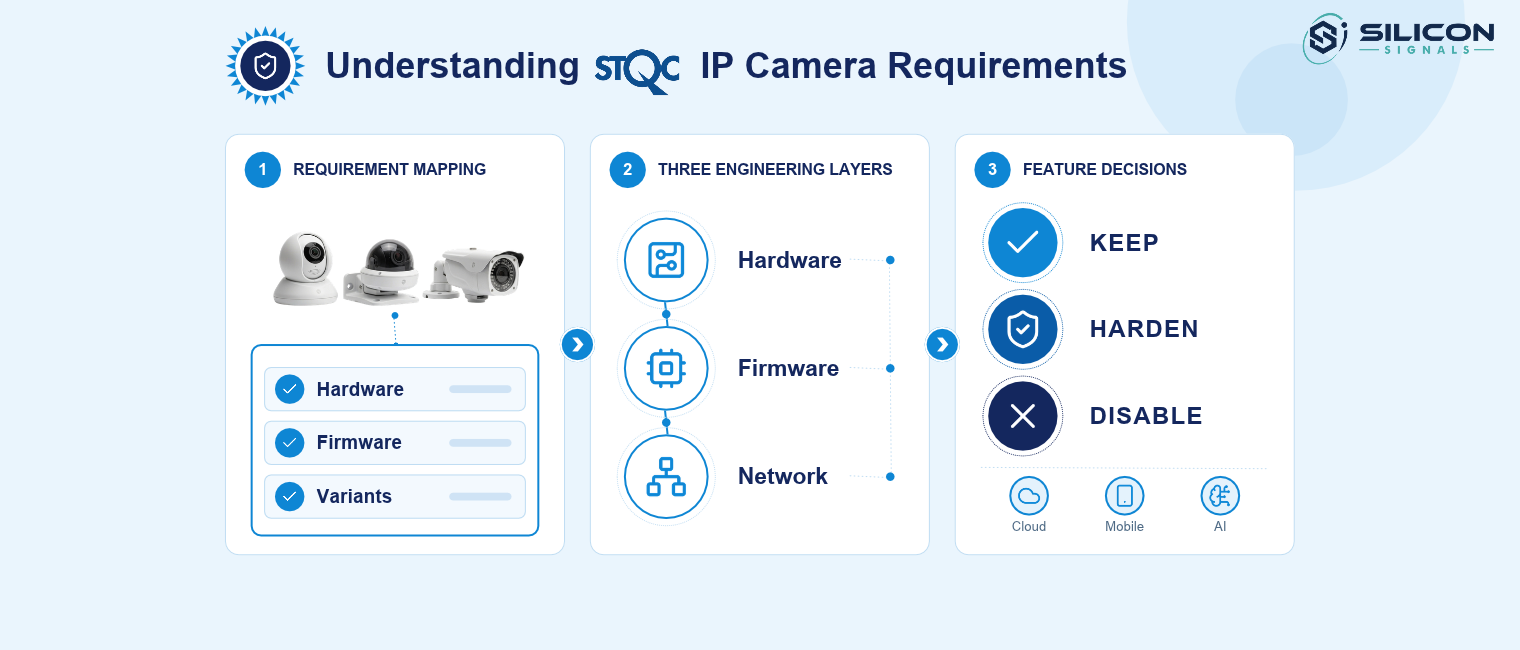
Mapping Applicable Requirements to the Camera Configuration
Create a matrix first. Place requirement clauses in the rows and camera hardware configurations and firmware revisions in the columns. A wired fixed camera will have a smaller applicable surface than a camera with Wi-Fi, ONVIF, Cloud, and Local Analytics.
The Lab tests the configuration you declare; therefore, declare it accurately. If a single product ships with several variants (same board and firmware) and different security configurations, document what is common across all variants, and provide a clear rationale for series claims.
Reviewing Hardware, Firmware, and Network Functions
Review the product with three viewpoints.
- With the hardware viewpoint, consider the SoC, memory, debug interfaces, secure storage, and component sourcing.
- With the firmware viewpoint, consider the bootloader, OS, services, and update logic.
- With the network viewpoint, consider the protocols, ports, encryption, and session management.
Findings that cut across viewpoints are the most critical. A UART console is a hardware feature. It exposes a firmware shell that can expose credentials and bypass network controls.
Aligning Product Features with Compliance Expectations
Product managers have to walk through the feature list and make decisions to keep features as is, harden features, or remove features in the certified configuration. Certain features such as remote access, cloud relays, mobile pairing, and AI analytics raise a compliance question. It is often more cost-effective to ship features disabled with a documented path to enable them as opposed to harden them two weeks prior to submission. CCTV compliance will always follow the decisions made by the product teams.
STQC Pre-Assessment Checklist for IP Cameras
Use this list as the entry gate for your STQC pre-assessment. Each item should close with evidence that a lab engineer can open and verify.
Product model and hardware revision clearly identified. Label the board, enclosure, and packaging with the same model’s name and revision. The unit submitted must match the declaration exactly.
Firmware version frozen for assessment. Tag one build and stop merging changes into it. Record the version string and image checksum in the submission pack.
Required product documentation compiled. Gather the technical file, user manual, declarations, and architecture description. Check that each document names the same model and firmware version.
Network services and exposed interfaces reviewed. List every open port and reachable interface with its purpose and protection. Remove anything that has no stated reason to exist.
User authentication and access controls checked. Test default accounts, password rules, lockout, and role separation on every access path. Confirm that no hidden maintenance login remains.
Firmware update mechanisms validated. Verify signature checks, downgrade rejection, and recovery after an interrupted update. Run the tests on the shipping build.
Security-related features tested on the actual product configuration. Test encryption, logging, and access control on production settings, not on a development image. Capture the results as dated evidence.
Third-party software and hardware components documented. List each component with its version, source, and license or part number. Match the list to the frozen build and the bill of materials.
Reviewing Hardware and Product Configuration
A STQC IP camera is evaluated as a physical sample, meaning that the hardware record must be for the exact unit that was evaluated. An inconsistency between the declaration and the unit on the bench will stall an evaluation faster than any other technical issue.
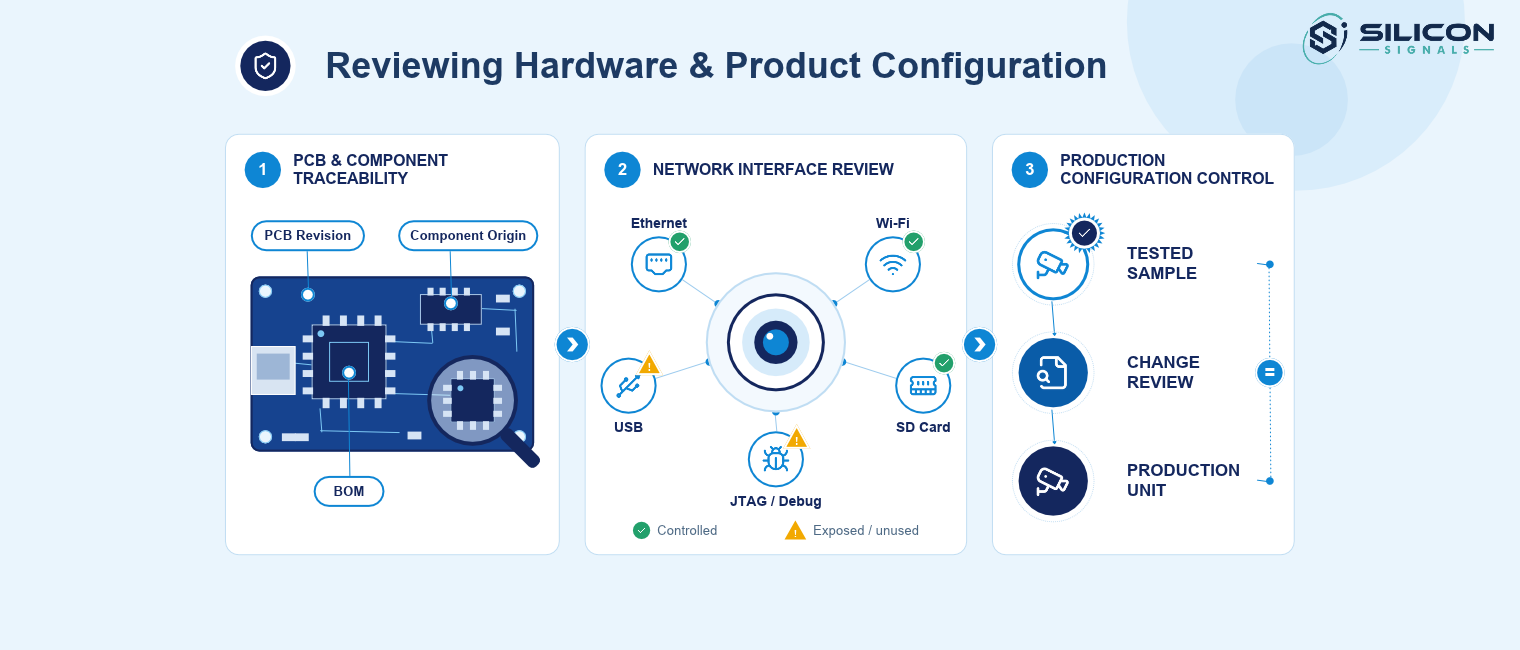
Checking PCB Revisions and Component Traceability
Record the PCB revision, assembly variant, and bill of materials revision for the submitted unit. Trace the main processor, memory, and wireless module and any secure elements back to supplier part numbers and lot numbers, where possible.
Substitutions made due to supply reasons (e.g., different vendors for flash memory) change the evidence trail even if the function is the same. Print the revision on the board and ensure the label, enclosure marking, and declaration is consistent. This traceability also helps supply chain transparency, which is emphasized in the Essential Requirements.
Documenting Network Interfaces and External Ports
List all interfaces a person or other device can reach. Interfaces include Ethernet, Wi-Fi, Bluetooth (if fitted), USB, SD Card slots, Serial Headers, and Test Pads that can be reached without disassembly. Describe the purpose of each. State if it is enabled in production.
Explain how it is protected. Disable all unused interfaces in either hardware or firmware and describe the changes. A JTAG header without readout protection, if populated, will gain the reviewer’s attention. This level of interface control is especially important for network-connected IP cameras, where exposed ports and debug paths can expand the attack surface.
Controlling Changes Between Tested and Production Configurations
Certification covers only the tested configuration. During production, the PCB assembly may be built into a different board variant. The certified bootloader may be replaced with a different one on the production line. A feature that was not tested may be enabled on the production variant.
The changes may be outside the scope of certification; however, they could impact compliance. Establish a change control process. Review any PCB or component change as well as a change to the firmware. Before releasing the PCB assembly, determine the impact on compliance. Label the gold sample so it may be compared to later units.
Plan Your STQC Pre-Assessment
Preparing Firmware and Cybersecurity Features
The Firmware carries the majority of the security behavior a lab will test. Most of these tests should be validated on the production-intent configuration before submission.
Reviewing Default Credentials and Authentication Controls
A lack of default credentials is one of the quickest paths to failing a security test for the camera. Make sure that the camera creates its own initial credentials or forces the end-user to create their own password during the first setup process. Additionally, make sure that the passwords can be created with certain constraints.
Also verify that administrative and viewing functions are separated. In addition to the web interface, verify that all of the camera access pathways are protected: ONVIF, SSH, RTSP, and any mobile interfaces. Hidden maintenance accounts should be removed, or at the very least, protected.
Checking Unnecessary Services and Open Network Ports
TCP and UDP scans of the camera should be performed using the shipping configuration. Compare the output to the documented list of services. There must be an owner, an authentication mechanism, and justification for all of the ports and services. Discover and control protocols from older SoCs may remain. Edge AI units often leave inference service endpoints, and model management ports open during bring-up.
Validating Secure Firmware Updates and Recovery Behaviour
Ensure that the camera does not allow any firmware that is not signed. Test the camera to see how it behaves when there are any software upgrades. See if the camera goes back to the correct firmware when power is interrupted while upgrading or writing firmware.
For Edge AI designs, verify the trust chain from boot ROM to bootloader, to kernel to application, including model files. Reviewers will most likely want to know how the signing keys are protected, so capture this in your document as well.
Documenting Software Components and Version Details
Make a list of the names and versions of the firmware components which include the kernel, bootloader, libraries, web server, codecs, and AI runtime. Give the license and the origin of each component.
Do a vulnerability assessment wherever possible for the components, show how the components are secured, and whether they are patched or not reachable. An automatic list created by the build process is more desirable than a manually made list. The code taken from the SoC vendor SDK must also be included, and an exhaustive list makes CCTV audits easy.
Conclusion
STQC Pre-Assessment transforms the certification process from gambling to a proper engineering exercise. Check hardware, firmware, network behavior, and documentation all together, confirm findings with proof, and freeze one configuration for submission. The team that follows this procedure goes to the lab with an STQC IP camera that acts as per its specifications, thereby keeping the CCTV certification on track. Silicon Signals specializes in camera design and helps OEMs prepare cameras for STQC certification.