
Introduction
A camera that streams flawless video can still be refused entry to the Indian market. Under MeitY’s CCTV rules, Essential Requirements testing is assigned exclusively to STQC, while BIS-approved labs handle safety testing reported by asmag. STQC camera testing now sits between every manufacturer and its first sale. Here is what STQC CCTV testing examines, and what OEMs need ready for STQC camera certification.
Preparing the firmware, hardware configuration, documentation, and test evidence early can make the process smoother. STQC-ready camera solutions help OEMs review these areas before submitting a camera for formal evaluation.
What Is STQC Camera Testing?
STQC camera testing is a lab evaluation of a camera against the Essential Requirements notified by MeitY. Labs working under the STQC Directorate verify the security claims a manufacturer makes about its device.
Why STQC testing is required for CCTV cameras
An IP camera can be referred to as a tiny networked computer. Such a device comes equipped with an OS, services, credentials, and it may share the same network as other enterprise devices. Insecure IP cameras have a history of being incorporated into botnets as well as providing the necessary entry points for lateral movement within the network. The regulators have reacted by ensuring that security becomes a gate rather than just a suggestion. As of June 6, 2024, it will be a requirement that the government-related CCTV cameras meet the Essential Requirements (STQC) as per the new amendment to the Public Procurement Order.
What does STQC evaluate?
The Essential Requirements include cyber security, hardware security, and traceability of the supply chain. The manufacturer presents a declaration of conformity along with the evidence, and a qualified laboratory performs testing of the device according to the declaration.
The testing lab not only reviews the documentation but also tests the working camera, the operation of the firmware, and the hardware components. A successful result of the STQC camera certification implies the fulfillment of notified requirements by the tested configuration.
STQC testing vs. general camera testing
General camera testing focuses on testing what the camera “sees,” including resolution, low-light performance, IR performance, compression, frame rate performance, and ingress protection. STQC testing of cameras tests how the camera holds up to being attacked.
This includes who is able to log in to the camera, which ports are responsive, and what happens when the firmware is attacked. The camera may take superb videos but still not pass any security tests. Teams that lump the two processes together realize too late in the process that both compete for the same firmware release.
Preparing Your CCTV Camera for STQC Testing?
What Security Checks Are Performed During STQC Testing?
Security checks start at the network edge and move inward toward stored data. The four areas below sit at the core of STQC CCTV testing.
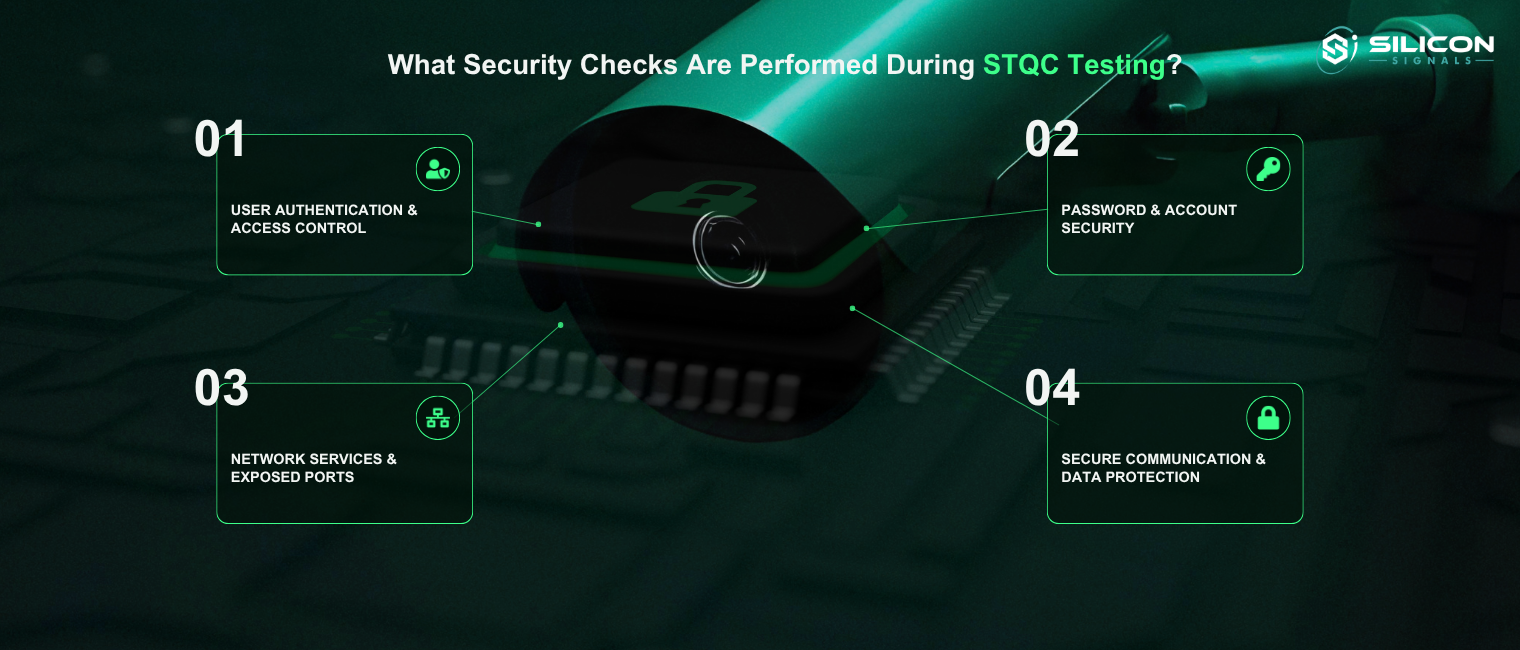
User authentication and access control
STQC camera testing requires the evaluation team to verify that every management interface requires authentication, including the web interface, vendor API, ONVIF services, and any stream endpoint that provides video access. They also check for separation of duties and ensure the viewer role cannot access configuration pages. A typical example of failure includes an old endpoint like a snapshot URL which gives an image without credentials.
Password and account security
This looks into the way passwords are generated, saved, and enforced by the camera. A common password that is the same for all devices coming out of the factory is going to stop the STQC certification of cameras. There are many original equipment manufacturers (OEMs) who make it mandatory for users to change the password at their first attempt at login. Other checks include password complexity requirements, lock-out after multiple failures, and storing the password in encrypted form as opposed to plaintext.
Network services and exposed ports
Port scans are performed on the camera by the lab, which then compares the discovered ports to the ones that the manufacturer claimed. Telnet, FTP, and debuggers are common discoveries. Listening services increase the attack surface, so they must match what is being claimed. UPnP is another protocol that is considered during STQC CCTV testing, as it is capable of opening ports on the router unknowingly to its owner.
Secure communication and data protection
It is important that video, credentials, and configuration data are transmitted through encrypted communication channels. This includes verifying whether the HTTPS settings are correctly configured and the TLS protocols and cipher suites supported by the camera.
In addition, they verify that the camera does not fall back to plaintext transmission when requested by a client. Secrets should be secured at the device level since the encryption of the stream itself is useless if the keys are in plaintext.
How Is CCTV Camera Firmware Checked for Security?
Most exploitable flaws live in firmware, so STQC CCTV testing spends serious time here. The lab examines how the firmware is built, delivered, and configured.
Firmware integrity and update mechanisms
Only firmware signed by the camera manufacturer should be accepted by the device. The testers will upload a modified photo to determine if the device accepts it. The way updates are handled and whether the update path is encrypted will also be tested. In addition, a situation where there is an inability to update will need to be assessed to ensure the camera is still in a secure state.
Default credentials and configuration
Besides any password-related discoveries, there are also assessments of your camera’s factory settings that could potentially introduce risks. Examples include debug flag options, test user accounts, example certificates, and liberal configuration settings that were never cleaned up from development testing phases. You must ship your camera with its settings tightened to allow for installation by installers.
Unnecessary services and interfaces
Embedded Linux builds contain unnecessary packages, including Telnet daemons included in BusyBox, package management utilities, and even compilers. Evaluators discover services running in a build whose purpose is unknown and undocumented. Such services are better removed entirely from the build than simply disabled through the web interface.
Software and third-party components
Dependency management for cameras involves open source libraries and chipset vendors’ software development kits. Supply chain transparency as an Essential Requirement means that OEMs must understand precisely what goes into their firmware images. Providing the list of versions of the kernel, OpenSSL, web server, and media library through the software bill of materials makes answering questions in the lab quick.
Open source dependencies that have vulnerabilities without patches become problematic, particularly those SDK packages taken directly from SoC vendor that were never reviewed before. Poor dependency tracking may be one of the simpler approaches to delaying STQC camera certification.
What Hardware Security Checks Matter for STQC Cameras?
Software hardening collapses if someone can open the housing and attach a cable. Hardware review in STQC camera testing covers what a person with physical access can reach.
Debug and service interfaces
The standard practice on camera boards is to include UART pads, JTAG or SWD pins, and even USB ports or serial console ports designed for factory programming. Evaluations involve testing these interfaces to determine whether or not they grant root shells and memory dumps on the final production hardware. They should be disabled at the boot loader level and at the fuse settings level while being depopulated wherever possible on the board.
Physical access controls
A hard-reset function must never grant administrative access without proper recovery mechanisms. Anti-tampering measures like security screws and anti-tamper alarms inside dome cameras increase difficulty. What becomes relevant here is how much damage can be done in two minutes while on a ladder with access to screwdrivers.
Storage and sensitive data protection
Footage, configuration files, and encryption keys are kept onboard. It is evaluated whether sensitive information is stored securely through encryption. It is determined where key storage occurs, whether it is secured appropriately, and if factory reset functionality clears credentials and certificates properly. The reused or refurbished cameras retain old user data without proper data erasure procedures.
Hardware and firmware interaction
The connection between firmware security and OS security is called secure boot. Secure boot is where the boot ROM verifies the bootloader, the bootloader verifies the kernel, and the kernel verifies the root filesystem. Any break in this chain invalidates the signature checks entirely. Testing labs verify secure boot implementations.
OEMs relying on chipsets providing a Hardware Root of Trust should ensure it is configured correctly using fuses in production, not just described in the datasheet.
How Should OEMs Prepare for STQC Camera Testing?
Preparation decides how many test cycles you pay for. Aim to hand the lab a unit that has already survived your own attack attempts and that supports a clean STQC camera certification result. Teams preparing for launch an STQC-ready CCTV camera brand in India usually focus on firmware hardening, internal security validation, and documentation readiness.
Security configuration before testing
Configure your release to build with unique passwords or required changes, disable any unnecessary services, enable HTTPS access only, and restrict debugging access. Always submit the exact same version of your build that will go live. Different configurations between sample builds and production compromise the efficacy and cause duplication of efforts within the STQC camera test phase.
Firmware and hardware readiness
Before Approaching the Lab, ensure the secure boot fuses are blown on the test units; the signing keys cannot be stored anywhere inside the development laptop. Confirm that the image validation flow will reject corrupted firmware packages. Ensure you document the hardware revision on the boards too, because hardware modifications since certification, like changing a flash memory or SoC variant, present situations the initial STQC camera assessment never envisioned.
Need Support With Your STQC-Ready Camera Project?
Documentation and test evidence
Labs operate with your declaration and test evidence. You must provide lab architecture diagrams, port/service listings, software bill of materials, update procedure descriptions, and Essential Requirement mappings. The last item is especially important because it enables quicker STQC CCTV testing for the lab team. If each Essential Requirement can be mapped to a feature, they know precisely which test to execute. Otherwise, they have to ask clarifying questions first.
Internal security validation
Port scanning, firmware extraction efforts, and fuzzing of your web server and RTSP services should occur internally prior to your product being exposed to STQC CCTV testing. Commercial scanners like Nmap, binwalk, and open-source vulnerability scanners uncover embarrassingly obvious issues inexpensively. Allocate this to someone without a direct programming stake in the matter because programmers typically test for what works.
What Happens If a CCTV Camera Fails STQC Security Checks?
A failed check usually produces documented findings that the OEM must resolve before certification moves forward. A failed STQC camera testing cycle costs more time than anything else, so a clean fix process matters.
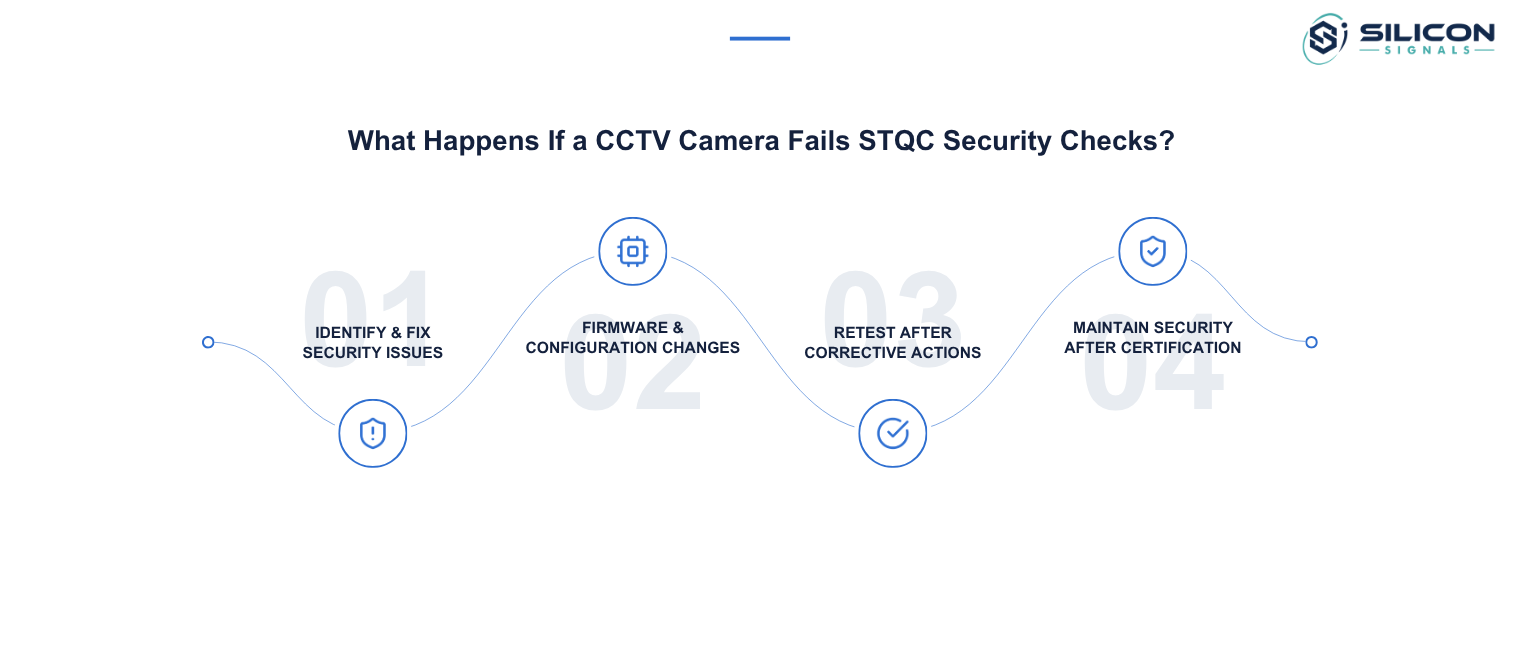
Identifying and fixing security issues
Trace the cause of each vulnerability. A Telnet port being open may be due to an init script or a vendor SDK initializing the service upon boot. Resolve the issue at its source and then look into the other models in the family that use the same base code and have the same vulnerabilities. The STQC CCTV testing of one model reveals vulnerabilities in other models derived from the same base code.
Firmware and configuration changes
The fix will often come with the next version of the firmware build or with new default settings. Be sure to properly version the build, document the changes made, and separate other feature-related coding from the fix. Otherwise, it becomes difficult for the lab to evaluate what requires further review.
Retesting after corrective actions
Lab confirms that all fixes cover all findings and no regression occurs. Provide the new screenshot, updated documentation, and a small note with a match between each fix and the corresponding finding. Depending on the lab and depth of changes made, the extent of retesting may vary, so do not wait to find out. Consider the retesting as an integral part of the STQC camera certification process.
Maintaining security after certification
Certification is applicable to the released version only. Any later versions, fixes, or updates should be done through proper change control. Keep track of any vulnerabilities with respect to your components list, release signed fixes, and validate that firmware changes require re-evaluation with the certification body. These controls are especially important for IP cameras and surveillance systems that remain connected to customer networks for several years after deployment.
Conclusion
STQC camera testing favors teams that incorporate security measures into their cameras from the design stage. Silicon Signals specializes in designing cameras and helping OEMs manufacture cameras ready for STQC CCTV testing.