
Intoducation
IP video surveillance systems accounted for more than 55.7% of the total video surveillance revenue in 2025, as per research by Grand View Research. Such demand allows newcomers to get access to the market. One no longer requires a factory to produce their own brand of CCTV cameras; what is required is a strategy and an engineering partner that will be able to implement it. The following guide describes how an IP camera ODM and a CCTV camera ODM can help you do so.
This approach works for brands building IP cameras and surveillance systems for retail, industrial, residential, and enterprise markets. The brand can focus on product positioning, customer experience, and sales, while the ODM handles the engineering and manufacturing foundation.
How Can You Build a CCTV Camera Brand Without Manufacturing?
The CCTV camera company owns the customer, the product definition, and the market positioning. It does not necessarily need to own the SMT line, the injection mold, or the testing fixture.
Using a CCTV Camera ODM
This is what ODM will do for you – design and produce cameras for sale under your own brand name. For your CCTV camera ODM, you get an out-of-the-box hardware solution, a tested firmware package, and an established assembly line. You only need to modify whatever needs modification in your CCTV camera brand, while leaving everything else as it is.
A standard cooperation between a company and IP camera ODM begins with developing a reference design based on an SoC from families of Ambarella CV, Rockchip RV1126, Novatek NT98, and others. Such chips integrate an image signal processor, video encoder, and, in some cases, a neural processing unit into a single package. This is the reason for the switch from cloud-based vision systems. Streaming all data from each camera to a server takes up bandwidth and introduces additional latency.
All pictures are processed locally using edge AI cameras, and only event and metadata transmission is done over the network. Your CCTV camera brand can support person and license plate recognition without requiring a multi-year silicon program through an IP camera ODM having a powerful hardware base.
Private-Label vs. Custom CCTV Cameras
Private labels refer to rebranding a camera from the ODM portfolio. The hardware, firmware, and housing remain unchanged, while only the logo, packaging, and software UI change. The release cycle is fast, measured in weeks, although competitors could get the same camera from the same CCTV camera ODM.
Custom implies specification of hardware changes, firmware functionality alterations, or image calibration. The development cycle lasts months, with engineering costs and tooling costs, but yields a CCTV camera product line that is difficult for others to replicate immediately. Many firms start with a semi-custom camera solution. They select a platform from the portfolio, alter the sensor or lens, add functionality via firmware changes, and calibrate the image for the specific market.
What the Brand Controls vs. What the ODM Handles
Brand owns the product definition, customer segment, pricing, firmware roadmap, cloud experience, and customer support. The ODM manages board design, driver design, manufacturing process, component procurement, and factory testing. The certification is always between these two parties, so it needs to be clarified in black and white.
The clearest division will let the brand own all aspects that the end user sees, and the IP camera ODM will own everything that the factory builds. This will make sure that you clarify who owns the source code and design files, which is crucial for future transitions.
What Does a CCTV Camera ODM Provide?
A camera ODM service includes all the engineering behind a CCTV camera, from the schematic to the box. This work is part of camera design engineering, which brings together sensor selection, PCB design, firmware, ISP integration, thermal design, and production support.
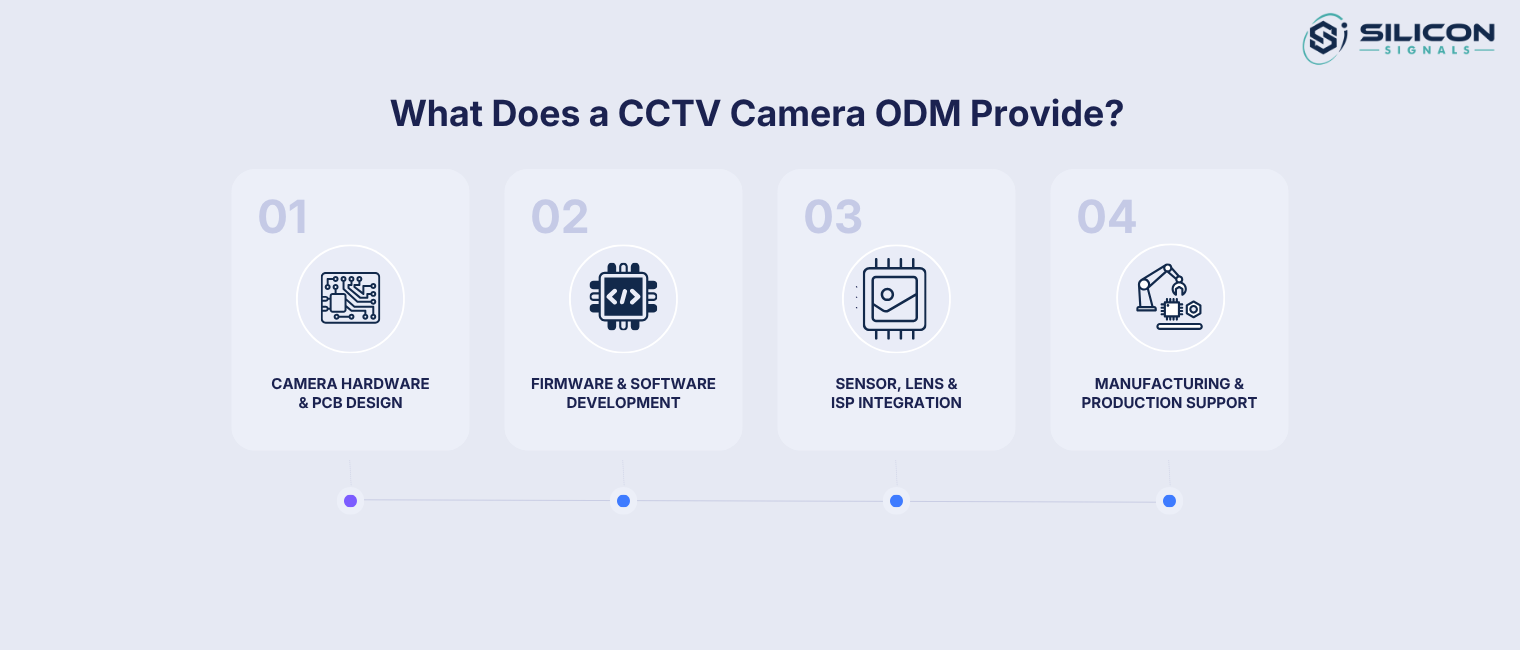
Camera Hardware and PCB Design
ODM uses the SoC to design the mainboard, which includes memory (DDR), flash, Ethernet, PHY, POE, and a microSD slot. The sensor boards, IR LED drivers, and audio board complete the electronics.
A good design should also account for heat dissipation since a 4K camera running with an NPU can overheat if there is no thermal path to the enclosure. A good IP camera ODM would have seen this when testing the design in a thermal chamber.
Firmware and Software Development
The firmware converts the hardware into a device. The ODM port Linux BSP fine-tunes the video path, RTSP streaming, and ONVIF Profile S & Profile T so that the VMS platform can find the camera. Also, the firmware builds the web UI, mobile applications, OTA upgrades, and security, including secure boot, firmware, and mandatory password change.
Check if the ODM of your CCTV camera supports on-device inference of models. Edge AI cameras require the toolchain for converting and quantizing neural networks for the NPU.
Sensor, Lens, and ISP Integration
Image quality results from balancing three elements. The sensor provides low-light and dynamic range capabilities. The lens defines sharpness, field of view, and infrared capability. The ISP pipeline, which can be tuned via software, performs noise reduction, wide dynamic range, and color processing.
Manufacturing and Production Support
The ODM carries out SMT assembly, lens focusing, waterproofing, burn-in, and final testing. Watch out for in-line tests such as focus tests, IR cut filter switching, PoE load tests, and IP67 water ingress sampling.
Component supply is important as well. In the past, shortages of memory and sensors have delayed releases; thus, a CCTV camera ODM that has reliable component suppliers keeps your schedule safe.
Want to Launch Your Own CCTV Camera Brand?
How Do You Create Your Own CCTV Camera Product Line?
Choose one hero camera to solve one problem, then offer variants on a common platform. Each option listed here impacts the cost, bandwidth, and quality of images from your CCTV cameras.
Choosing Camera Form Factors
Bullet cameras are good for outdoor perimeter and long-throw applications. Dome and turret cameras can be used in ceiling-mounted and anti-tampering environments. PTZ cameras can cover a large area with a single camera but are expensive and have additional moving parts. Fish-eye and multi-sensor cameras are ideal for open floor areas.
Choose two to three form factors when launching. The IP camera ODM will benefit in development expense and firmware maintenance by using a common main board for bullet, turret, and dome types.
Selecting Resolution and Image Sensors
Resolution does not necessarily mean higher quality. An 8MP camera is inferior to a 4MP camera in terms of night vision because of the bigger sensor. The H.265 codec reduces bitrate, yet an 8MP stream remains too much for storage and switchers. Resolution should be adjusted to the scene.
A parking lot requires pixels to be pointed at plates, but 4MP is enough for a retail aisle.
Customizing Branding and Product Features
Brand identification is not only a logo. Branding includes the theme of the web interface, boot screen, default configuration, mobile application, product packaging, and user manual. The features distinguish one CCTV camera brand from another generic product listing.
Features like two-way audio, deterrent white light, onboard siren, and onboard person/vehicle detection are common distinguishing factors.
Developing Application-Specific Cameras
Focusing on applications provides a relatively new brand with an opportunity to fight large brands. A license plate capture camera requires a varifocal lens, rapid shutter operation, and infrared capabilities to avoid plate glare. A retail people-counting camera requires a wide-angle, ceiling-mounted lens and an on-device model. A warehouse camera can require low-light capability and forklift or helmet detection.
Every application scenario allows you to choose your CCTV camera brand based on results rather than megapixels due to edge AI.
How Much Customization Can a CCTV ODM Offer?
Customization can be anything from changing the logo to an entirely new design, depending on the competence of the engineering team at the IP camera ODM and also depending on the volume. A competent IP camera ODM should be able to offer four different customization options.
Custom Hardware and Enclosure Design
Molds have to be made for enclosure changes, which will take time and money. A lot of vendors start from a catalog enclosure and change the front bezel or its color only. Changes in hardware might consist of a new sensor board, more I/O like an alarm input/output, RS485, and even a cellular module. Please ask about the tooling price and who owns those molds.
Firmware and User Interface Customization
Firmware customization includes the web UI, application integration, network behavior by default, language packs, and cloud connectivity. There is no single cloud provider for all CCTV cameras; some use the cloud services of their brand, whereas others use ONVIF and local storage. You should ask the manufacturer of your CCTV camera ODM to provide an SDK or API for feature addition.
Image Quality and ISP Tuning
ISP tuning will determine how your camera will behave in reality. ISP engineers tune noise reduction, sharpening, exposure goals, and WDR parameters to suit scenes like backlit entrances or night car parks. Make sure you ask for some raw samples in the relevant environment prior to the commitment. ISP tuning can distinguish your CCTV camera line better than any hardware tweak, since it is all about night video.
Connectivity and VMS Integration
The camera should be compatible with the customer’s needs. The ONVIF Profile S and T conformance applies to all the VMS products like Milestone and Genetec, although some might require additional testing. Ethernet PoE connectivity is common, but Wi-Fi, 4G, or PoE extenders will do well in distant locations.
In case of AI cameras at the edge, ensure that detection events can be sent in ONVIF metadata or in MQTT protocol so that actions from VMS can follow. A good test of an IP camera ODM involves the two pathways with actual VMS software rather than on the bench.
What Should You Check Before Choosing a CCTV ODM?
Start with the check on engineering depth and then move to capacity, compliance, and support. A company that has a product catalogue is different from an ODM CCTV camera company.
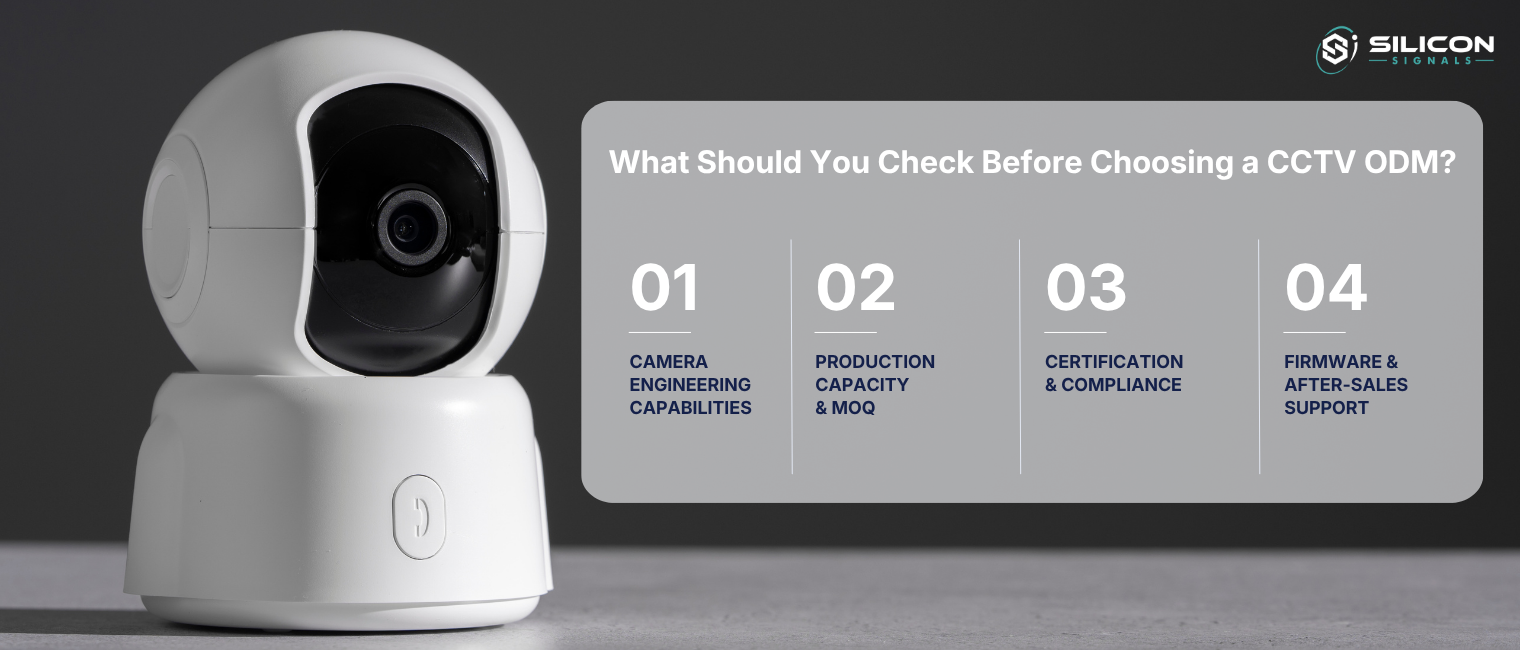
Camera Engineering Capabilities
Ask them how many engineers they have working on hardware, firmware, and ISP optimizations, and the SoC platforms they have shipped to date. Ask for samples of their cameras, testing reports, and customer references. An ODM who has shipped an edge AI product can demonstrate their NPU benchmarks and model optimization process. An ODM who has not is simply reselling a vendor reference design.
Production Capacity and MOQ
Minimum Order Quantity will determine the cash flow. The Catalogue Design could have a minimum order of a few hundred pieces, whereas Custom Designs could have a higher minimum order due to Tooling and adjustments required. Enquire about their capacity per month, lead time, and how they handle a volume surge.
Certification and Compliance Support
Cameras to be sold in different regions require STQC, BIS, NDAA, FCC, RoHS, and usually UL or regional certifications. In addition, the Indian government and many enterprises will require compliance with STQC and BIS for components. Europe is taking steps towards mandating cybersecurity standards via the Cyber Resilience Act. Find out from the CCTV camera ODM what they have already done for the base platform and who pays for retesting yours.
Firmware and After-Sales Support
Cameras remain in the field for many years. Find out about the duration of support, the time for fixing vulnerabilities, and the warranty coverage. Make sure you know the location of the source code escrow and the process for processing RMA units. An inexpensive device with no firmware updates will tarnish your CCTV camera brand faster than a delayed release.
Ready to Build Your Own IP Camera Brand?
How Do You Launch a Production-Ready CCTV Brand?
Go from prototype to validation, to certification, to pilot manufacturing, and then to launch. For a step-by-step view of entering the market with a branded camera line, see how to start a white label CCTV camera brand.
Prototype and Camera Validation
Test image quality, thermal efficiency, PoE certifications, and stability of samples. Run the cameras for several weeks and stream them into the video management system (VMS) of your choice while running edge AI algorithms under various weather and lighting conditions. Record each failure and request root cause analysis from the ODM prior to testing the next version.
Compliance and Certification
Ship design units off to accredited labs for EMC, safety, and ingress protection tests, and ensure ONVIF compliance if you claim it. Schedule this as soon as possible because delays in the queue at the lab could add weeks. Changing a part post-certification might mean partial retesting, so lock down the bill of materials first.
Production and Quality Control
Make a small quantity in hundreds to begin with before production on a large scale. Set up certain criteria for acceptance in terms of the percentage of defects, tolerance of focusing, and testing process, along with third-party testing before shipment. Maintain records on the serial number and firmware version used to trace field issues to that specific build.
Branding, Packaging, and Market Launch
Select packaging, a quick start guide, a datasheet, and an installation guide. Establish good rapport with distributors and system integrators, since they are the ones who decide which products should be installed. Provide demo units and support channels. Introduce the product, get feedback, and extend the CCTV Camera ODM platform to other variants.
Build Your CCTV Camera Brand with the Right Engineering Partner
A CCTV camera product is successful by combining vision and good engineering of the product. Select a camera ODM that has knowledge of hardware, firmware, and edge AI design and set the terms of ownership at the start of the relationship. Signals is a camera design company specializing in camera development, from sensor and ISP selection to production-ready designs. If you are planning a camera line, speak with its engineers about your requirements and timeline.