Meet us at IFSEC India 2026 | 3 to 5 December | Bharat Mandapam, New Delhi | Stand G05, Hall 4 Book a meeting →

Why Cybersecurity Is Now Critical for IP Cameras

Table of Contents

Intoducation

An IP camera sits on the same network as finance servers, access control panels, and production systems, yet many units ship with consumer-grade defenses. Forescout’s study in 2024 of more than 18 million devices revealed an increase in the percentage of IoT devices vulnerable to attacks from 14% to 33% in one year; IP cameras are one of the IoT device types most at risk (Infosecurity Magazine). This trend makes IP camera cybersecurity an essential consideration in all products’ roadmaps. Below is an outline of the various security threats, firmware management practices, design techniques, and testing approaches.

Why Is IP Camera Cybersecurity Important?

IP camera cybersecurity matters because a camera is a networked computer that records sensitive footage. A weak device gives attackers a foothold, a data source, and a launch point.

IP Cameras Are Connected to Business Networks

A typical deployment joins cameras to the same switches that carry office, badge, and building traffic. An attacker who controls one camera often reaches its neighbors, because flat networks rarely inspect traffic between devices. Compromised cameras have also served as botnet nodes that send traffic to third parties. CCTV cybersecurity now belongs in IT policy, not only in the security office’s budget.

Cameras Can Expose Sensitive Video and System Data

A camera holds more than a video. Its memory can hold credentials, network settings, Wi-Fi keys, and integration tokens for recorders and cloud services. Live streams can reveal shift patterns, restricted areas, and screen contents. One leaked feed from a warehouse or lab exposes operations and can trigger compliance problems under privacy laws.

Cybersecurity Risks Can Affect More Than the Camera

Consequences travel beyond the device. A hijacked camera can take down a recorder, disrupt a video management system, or give an attacker a pivot into the wider LAN. Buyers then face downtime, forensic work, and lost trust in the manufacturer.

Poor IP camera cybersecurity in one model can force a fleet-wide patch campaign, and CCTV cybersecurity teams absorb the workload.

Why Security Should Be Considered During Camera Design

Retrofitting protection after release costs more and leaves gaps. Design decisions made early in development constrain the firmware attack surface. Prior to creating a secure IP camera schematic, hardware modifications can be made. During this phase, designs can be adjusted to pass client evaluations. Modifications to prepare for production are rarely necessary.

What Are the Main Cybersecurity Risks for IP Cameras?

Most camera breaches trace back to a short list of design and configuration gaps.
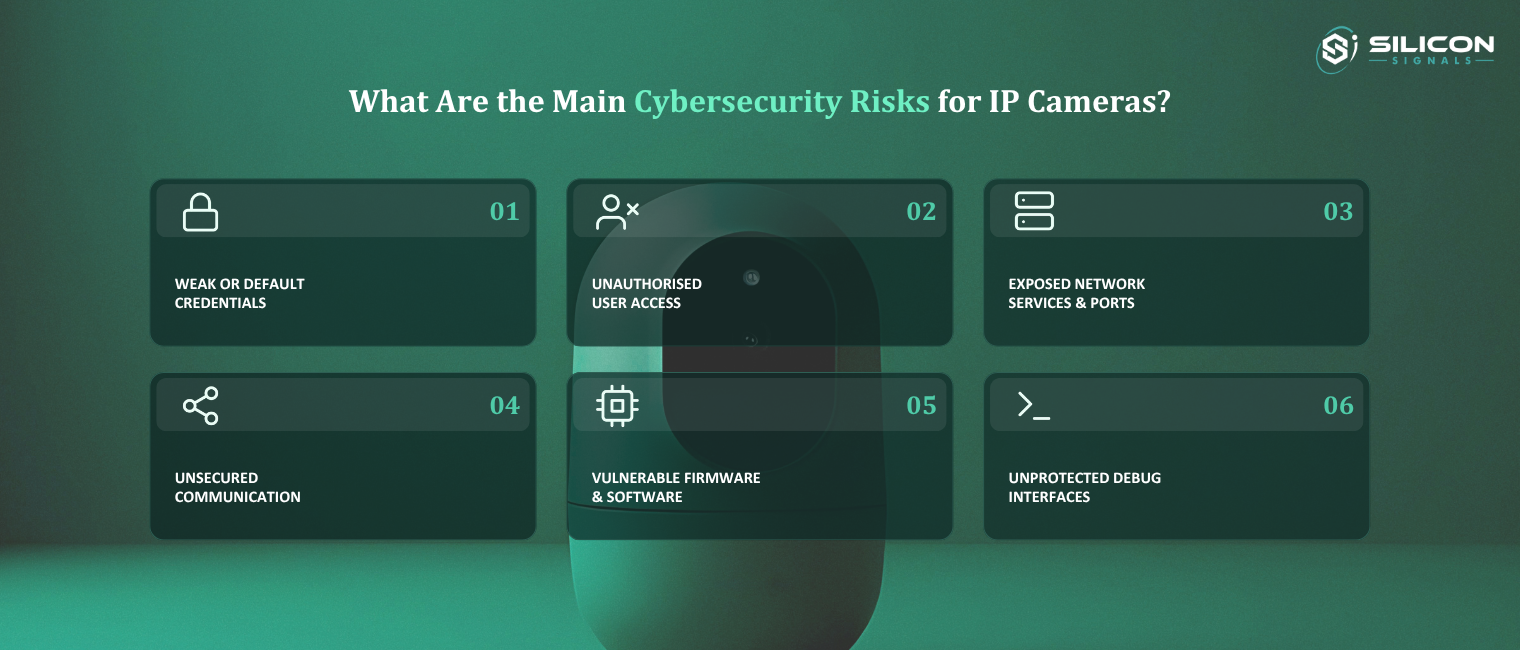
Weak or Default Credentials
  • Factory passwords shared across a product line let one leaked login open thousands of devices.
  • The Mirai botnet in 2016 recruited cameras and DVRs using a short list of factory logins.
  • Setup flows that skip a forced password change leave the weakest configuration in place.
Unauthorised User Access
  • Missing account lockout allows unlimited guessing against the web interface or API.
  • Flat privilege models give every user administrator rights.
  • Stale accounts from former installers or staff stay active long after they leave.
Exposed Network Services and Ports
  • Telnet, FTP, and unused UPnP services widen the attack surface without adding value.
  • Management ports on public IP addresses attract automated botnet scans.
  • Unencrypted HTTP still runs many cameras in the field.
Unsecured Communication
  • Video sent over plain RTSP or HTTP can be captured on the local network.
  • Weak TLS versions and unchecked self-signed certificates invite interception.
  • Unprotected API calls between cameras and recorders can be replayed or altered.
Vulnerable Firmware and Software
  • Outdated open-source libraries carry known CVEs long after fixes exist.
  • CVE-2021-36260 in Hikvision web servers allowed unauthenticated command injection through a crafted request.
  • Vendors without a patch schedule leave buyers unable to plan maintenance.
Unprotected Debug and Service Interfaces
  • An open UART console often gives a root shell with no login.
  • JTAG and SWD ports let an attacker read flash memory or halt the processor.
  • Leftover factory test modes stay active in production images.
Building a secure IP camera for your next product?
Silicon Signals helps OEMs integrate cybersecurity into camera hardware and firmware, including secure boot, access controls, network security, and protected system interfaces.

How Does IP Camera Firmware Affect Cybersecurity?

Firmware decides how the camera authenticates users, stores passwords, and interprets network inputs. This makes firmware at the level that most often determines the success of IP camera cybersecurity.

Authentication and User Management

Firmware needs to mandate a unique password upon first-time login, use a salted hash function to store the credentials, and disable the account upon failed logins. It should also be able to connect to the directory services for the sake of business customers if needed. The lack of the above features would make every subsequent control rely on a vulnerable login process.

Role-Based Access Controls

It is critical to create multiple levels that separate the role of viewing the live video from the role of changing network settings. There must be a minimum of three such access levels (viewer, operator, administrator), and the separation should exist both in the API and UI.

Secure Configuration Management

Configuration files contain passwords, certificates, and server endpoints. They should be encrypted, their backups signed, and all imported files verified. Offer an out-of-the-box hardened configuration, which means an installation begins in its most secure form and opens only those services required by the website.

Firmware Integrity and Secure Boot

Secure boot will check the integrity of each step of the boot process, including the ROM bootloader, kernel, and root filesystem, using a signature linked to hardware. An unsigned or modified image will not start. It works well with update packages and rollback mechanisms to prevent installation of outdated firmware versions.

Security Updates and Vulnerability Patching

Patching requires a reliable process. Keep track of third-party software via a software bill of materials, follow up on security advisories for them, and roll out patches according to a public schedule. Have tools for updating or over the air, as patches that installers cannot apply will never reach most cameras.

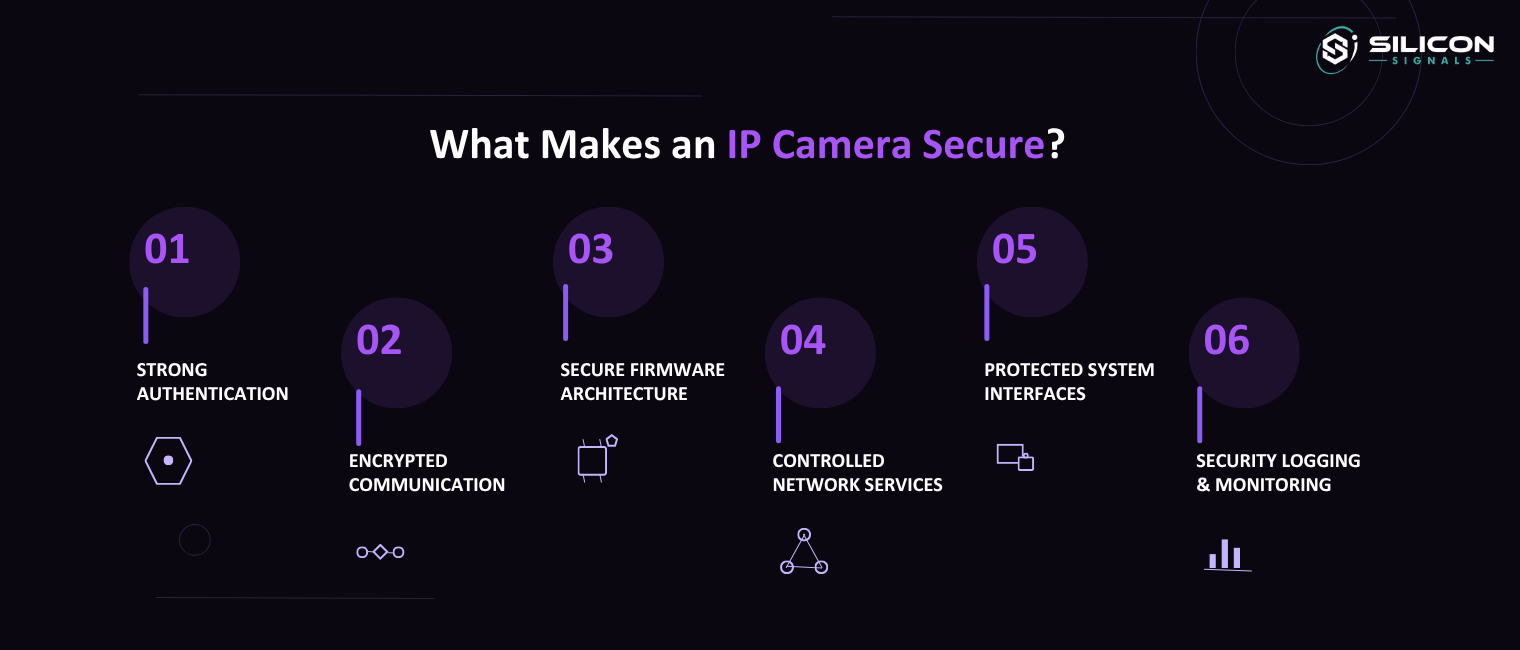
What Makes an IP Camera Secure?

A secure IP camera combines hardware protection, hardened firmware, and disciplined operations. No single feature covers the gap left by the others.

Why Cybersecurity Is Now Critical for IP Cameras
Strong Authentication and Password Policies

Look for enforced complexity, unique per-device defaults or mandatory first-login changes, lockout after failed attempts, and support for certificate or token-based access. Multi-factor sign-in for administrator accounts adds another barrier when cameras serve remote users.

Encrypted Network Communication

Current TLS for the web interface and API, secure RTSP or SRTP for video, and 802.1X for network admission keep traffic private and confirm device identity. A secure IP camera also disables outdated protocol versions and validates certificates rather than accepting any that a server presents.

Secure Firmware Architecture

The secure firmware operates with least privilege, segregates the video processing path from the management process, and ensures that the key material remains in a physically isolated environment, like the secure element or TrustZone. The coding for memory safety and compiler hardening mitigates vulnerabilities in the network input parsers.

Controlled Network Services

Every listening port needs an owner and a purpose. A secure IP camera ships with only HTTPS, and its video protocol enabled, keeps discovery and legacy services off by default, and lets administrators bind services to specific interfaces. Fewer exposed services mean fewer entries in an attacker’s scan results.

Protected System Interfaces

Production units should lock UART, JTAG, and USB service modes through fuses or authenticated access. Remove development tools, test accounts, and verbose debug logging from release images. Physical access to the board then yields far less than it does on an unprotected design.

Security Logging and Event Monitoring

A camera must keep logs for logon, attempted logon, configuration changes, firmware changes, and service restarts along with trusted timestamps. These logs need to be sent to a syslog or SIEM server. Effective CCTV cybersecurity depends on this visibility.

How Does CCTV Cybersecurity Affect Camera Deployment?

CCTV cybersecurity decides whether a well-built camera stays safe once installers connect it to a live business network.

Secure Network Integration

Place cameras on a dedicated VLAN, and restrict traffic to the recorder, the video management system, and the update server. Block outbound internet access unless a service needs it. This segmentation limits what a compromised camera can reach, which is the core goal of CCTV cybersecurity on a shared network.

Access Control for Administrators and Users

Give each person a named account, and remove access when installers, contractors, or staff move on. Restrict administrator functions to a management network or jump host. Account hygiene is a routine part of CCTV cybersecurity, and shared logins make it impossible to trace who changed a setting.

Protecting Video Streams and Stored Footage

Encrypt streams between cameras, recorders, and viewing clients. Encrypt stored footage at rest, and limit which accounts can export clips. Set retention periods that match privacy rules, because footage kept longer than needed adds legal exposure without adding value. Good CCTV cybersecurity covers the recording path from lens to archive.

Managing Remote Camera Access

Disable Unsolicited Puts on Network (UPnP) on your routers to prevent your cameras from creating rules to bypass your firewall. Protect pathways that grant remote access very carefully. Management interfaces of CCTV systems should be protected as if you are protecting any other management interfaces to an organization’s IT systems.

Maintaining Security After Deployment

A deployment stays secure only while someone watches it. Keep a record of models and versions of firmware, implement updates according to schedule, rotate keys and passwords, and keep a lookout for unusual behavior in the logs. Site managers who enforce good security practices for IP cameras also replace the cameras when the vendor no longer releases updates for that model.

Planning an IP camera with security built into the design?
From hardware architecture and firmware to cybersecurity testing and production readiness, Silicon Signals helps OEMs develop secure, reliable IP camera platforms.

How Should OEMs Test IP Camera Cybersecurity?

OEMs should test IP camera cybersecurity across access, network, firmware, and hardware paths before every release.

Test Authentication and Access Controls

Try default logins, brute-force attempts, lockout bypass, session hijacking, and direct calls to administrator endpoints from a viewer account. Confirm that password resets, token expiry, and logout behave as designed. Any path that skips authentication counts as a critical finding.

Review Network Ports and Services

Run full TCP and UDP port scans against a factory-fresh unit and a fully configured unit, then compare the results to the documented service list. Investigate every unexpected listener. Tools such as Nmap reveal exposed services quickly and belong in the release checklist.

Check Firmware and Software Vulnerabilities

Scan the firmware image against known CVE databases, review the software bill of materials, and fuzz the parsers for RTSP, ONVIF, HTTP, and file uploads. Combine static analysis with manual review of web handlers, since injection flaws often hide in code that builds shell commands. Repeat this work for every release, because IP camera cybersecurity posture changes as components of age.

Test Communication Security

Capture traffic between cameras, recorders, and client to confirm that encryption is active. Check TLS versions, cipher suites, and certificate validation. Attempt downgrade and man-in-the-middle attacks. A secure IP camera should refuse a forged certificate and drop any connection that falls back to plain text.

Inspect Debug and Maintenance Interfaces

Open the enclosure, probe for UART, JTAG, SWD, and exposed flash pins, and attempt to gain a shell or dump the firmware. Verify that production images lock these paths. Repeat the check after each hardware revision, because board changes often reintroduce test headers.

Validate Security Under Real Deployment Conditions

Lab tests miss what happens on a busy site network. Test with NVRs, VMS platforms, 802.1X switches, and remote access paths in place. Commission for a third-party penetration test before release, then retest after major firmware updates. This step confirms that CCTV cybersecurity controls are held outside the lab.

Conclusion

IP camera security is determined during design and manufacturing, not during sales. Cybersecurity is viewed as one of many design constraints. Omitting any step weakens the overall security of the product. Many of the design trade-offs for product security and cybersecurity impact can be addressed through manufacturing decisions. For cybersecurity to be incorporated into a product, it must be incorporated into the design.

OEMs that integrate IP cameras into their products benefit from incorporating cameras that contain security features during design in order to defend against attacks and ease regulatory compliance. Silicon Signals has integrated product security and Cybersecurity design features within IP Cameras during the design and manufacture process.

About the Author

Picture of Ankit Siddhpura
Ankit Siddhpura
Sr. Android BSP (AOSP) Engineer at Silicon Signals Pvt. Ltd. An active contributor to LineageOS and Google AOSP, Ankit has expertise in Qualcomm Multimedia. With a deep understanding of the mm-camera stack, Ankit enhances valuable customer experiences.